November 10 , 2026, Hong Kong

Cassidy Dart MW on China's consumers, competition and commercial realities.
For international wine producers, China has long represented both an enormous opportunity and an extraordinarily difficult market to understand. Its population, economic scale and growing wine culture have attracted producers from around the world, but the assumptions that shaped the first wave of international expansion no longer hold.
Cassidy Dart MW has spent years living and working in China and advising wineries on market entry and commercial strategy. He has watched the market move from an era heavily influenced by gifting and government-related business dining towards a smaller but more professional consumption base, while online retail and Chinese social platforms have fundamentally changed how brands reach consumers.
Ahead of judging at the China Wine Competition, Dart offers a notably pragmatic assessment of where China's wine market stands today, what international producers continue to misunderstand, and why success in Asia requires a different strategy rather than simply exporting the playbook that worked in Europe or North America.

Image: Cassidy Dart MW
You've lived and worked in China through one of the most transformative periods for its wine industry. If you had to describe today's Chinese wine market in three words, what would they be, and why?
Maturing, dynamic, competitive. Maturing because we are entering a secondary phase (the era of gifting and government-related business dining occasions is over), with less, but real consumption, and likewise fewer importers but increased professionalism. Dynamic because of the growth of online sales and social media presence across multiple Chinese platforms, crucial for brand awareness and speed of sale to consumers. Competitive because of the economic squeeze and specificities and uniqueness of the Chinese market; once a particular category does well, such as Riesling or Sauvignon Blanc, then typically a flood of cheap wine hits the market, putting huge pressure on price.
Many producers still see China as one enormous market. In reality, how different are today's wine consumers across China and the wider Asian region?
China should be considered a continent. Different economies, different foods, different languages, different cultures, and consumption habits. Shanghai, for example, is the most mature market, which has very different consumers from Chengdu. Saturation in mature cities vs 2nd/3rd tier cities. Outside of mainland China, Japan and Hong Kong are very mature markets with their own specificities (for example, natural wine in Japan and Burgundy /Champagne centric in HK). No one-size-fits-all
You advise wineries entering Asia. What's the biggest misconception international producers still have about selling wine in China?
The size of the market! In fact, the real market for wine in China is probably somewhere between 30-50 million people (if we assume “real” as drinking wine more than c. 6 bottles a year). Western cues such as critics' scores, wine descriptions featuring fruits that are not familiar to the Chinese palate, and too much emphasis on production or appellation remain issues. Reluctance to visit and support the market and understand what happens on the ground are constant hurdles. Selling one pallet/container of wine and not following up and supporting the importer, and then wondering why there are no repeat orders.
Consumer tastes continue to evolve. What styles of wine, occasions, and buying behaviours are gaining momentum, and what trends do you think the international trade is still underestimating?
The importance of localised content and partners, the growth of white wine, the evolution of wine consumption occasions, and increased purchasing via instant retail (a bottle of wine can be delivered to your apartment in 20 mins, ice cold if necessary), and the importance of brand building via social media before trying to find an importer. In terms of wines, it is well known that white wine is doing well; aromatic wines specifically and lighter reds, I think, all have a strong future.
Storytelling has become increasingly important in wine marketing. From your experience, what kinds of brand stories genuinely resonate with Asian consumers, and which messages tend to fall flat?
We still talk too much about the uniqueness of the production method, tiny volumes/allocations, and a family-owned narrative, which I feel resonate less in Asia, but it is hard to generalise. The most important thing is a sense of authenticity, and also who and how that story is delivered, and also less on education but more about sharing and why it should be consumed, what value it brings, and what it says about them when they drink it.

Image: Wine tasting at Interprocom.
You've worked with wineries on market entry and commercial strategy. If a producer had just one opportunity to present their wines to an importer or distributor in China, what would you want them to demonstrate beyond the quality of the wine itself?
Demonstrate existing global demand first, commit to building out the brand in China, ideally online rather than assuming that the market needs another specific wine. Continual upfront investment is required, as is a long-term strategy with patience! Commitment to managing the price structure with the right partner is paramount.
As a judge at China Wine Competition, you're evaluating wines through the lens of Asian consumers and trade buyers. What qualities consistently separate wines that succeed in this market from technically excellent wines that never quite find commercial success?
This is a very difficult question to answer. Embossed bottles, and unfortunately heavy bottles, still have their place in certain cities and to a certain demographic, but ideally a Chinese translation that is meaningful and easy to say, and sometimes, what we think is an awful label from a Western perspective can work very well.

Image: 2025 China Wine Competition.
Looking ahead five years, what developments do you think will reshape the Asian wine market, and where should producers be investing their attention today?
In Europe and North America, we see a combination of factors: decreasing alcohol consumption, very mature European markets, growth of the anti-alcohol movement, the health and well-being movement, as well as inflationary and economic pressure, which signal that we should be looking East rather than West, but it requires time, money and investment with a specific strategic approach not the same playbook that has worked elsewhere. I believe that wine still has very strong credibility to offer consumers: cultural, historical, flavour, complexity, and the ability to enhance social and business occasions as well as be a bridge between East and West, but it requires sustained, strategic efforts, particularly given the current existential situation it faces. We have to build for the future, not rely on historical markets.
Living in Beijing has given you a front-row seat to one of the world's most dynamic food and wine cultures. What's the most memorable food and wine pairing you've experienced in Asia that completely changed your perspective?
For the most part, I don’t really think about food and wine pairing, because for me it is only relevant in certain specific scenarios, and we alienate more consumers by using food and wine pairing as yet (another!) gap between consumers and wine. But possibly, and definitely not intentionally, it was in Chengdu, a very memorable pairing of 老妈蹄花, which is a sort of pig’s-trotters soup, often consumed on the street, with Krug at 3 am!
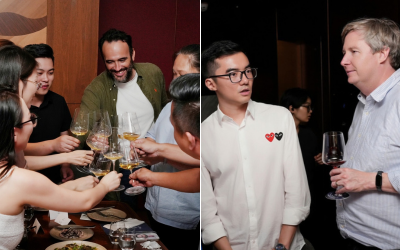
Image: Interprocom & friends gathered along with Cassidy Dart MW.
Conclusion
Cassidy Dart's view of China is ultimately more nuanced than the conventional story of a vast emerging wine market waiting to be tapped. The market has matured, consumption has become more selective, importers have become more professional, and competition has intensified. At the same time, digital commerce, local social platforms, changing drinking occasions and the growing interest in white and lighter wines are creating new opportunities.
For international producers, the lesson is less about finding the right bottle and more about committing to the market. China cannot be approached as one homogeneous consumer base, nor can strategies developed for Western markets simply be translated into Chinese. Local partners, local content, appropriate pricing, sustained investment and genuine engagement with consumers increasingly matter as much as the wine itself.
For Dart, the broader opportunity extends beyond China. As established Western markets contend with changing consumption patterns, economic pressure and the moderation movement, Asia offers an important part of wine's future. But that future will not be built by assuming that Asian consumers should be sold wine in the way Western consumers have been sold wine for decades.
It will be built by understanding the markets on their own terms.
And perhaps his most memorable example makes the point better than any market statistic could. A bowl of Chengdu pig's-trotter soup, a bottle of Krug, and 3 am may not appear in any conventional wine-pairing guide. It does, however, capture something important about the opportunity in Asia: wine doesn't need to fit an established Western template to have a place in people's lives.
In conversation with Malvika Patel, Editor and VP, Beverage Trade Network
Also Read:
What Makes A Wine Brand Relevant To Today’s Chinese Consumer?
From Bordeaux To Hong Kong: Dominique Noël’s Unfiltered View On Wine Buying
What Sells Wine In Hong Kong? Kevin Suen Shares A Ground-Level View
The 2025 China Competitions results are now live. View 2025 winners.
Key Dates
Early Bird Deadline: July 31, 2026
Regular Deadline: October 14, 2026
Warehouse Deadline: October 22, 2026
Judging Date: November 10, 2026
Winners Announcement: November 24, 2026